
Fairness-Aware Federated Domain Generalization for Multi-Center Medical Imaging in Low-Resource Hospitals
Fairness-Aware Federated Domain Generalization for Multi-Center Medical Imaging in Low-Resource Hospitals
Description
Details
Context and Problem Statement
Federated learning is widely proposed for medical-data collaboration, yet many evaluations assume relatively homogeneous centers. In reality, large university hospitals may dominate aggregation while regional hospitals with older equipment remain underserved.
Research Question
How can federated aggregation improve performance at the worst-performing site without materially degrading average performance under strong equipment and protocol heterogeneity?
Proposed Approach
Compare fairness-aware aggregation, local personalization through adapters, image harmonization, and domain-generalization techniques. Evaluate per-site performance, inter-site disparity, and subgroup fairness when demographic information is available.
Expected Contribution
An empirical characterization of the fairness-performance trade-off under realistic federated medical-imaging heterogeneity.
Expected Prototype
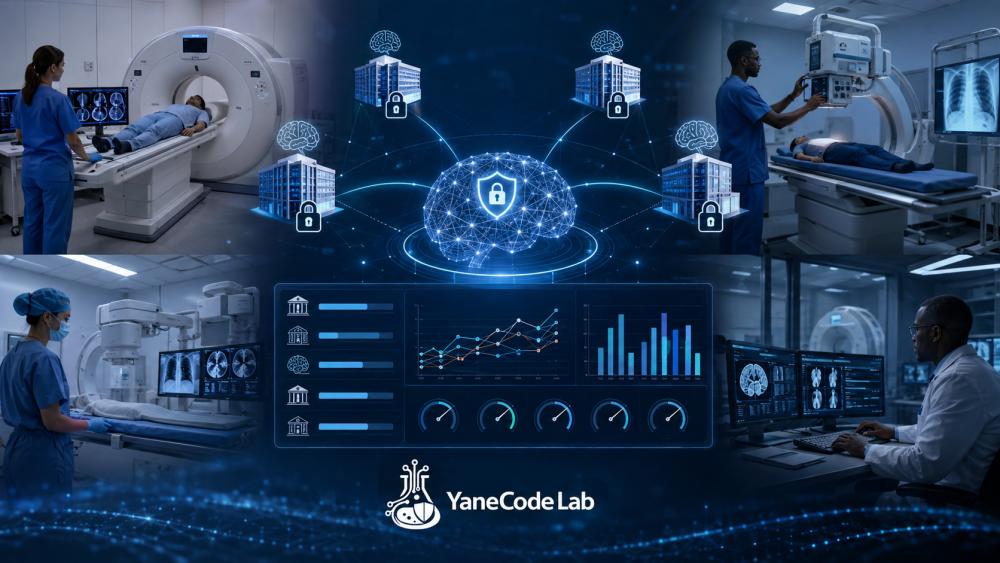
A federated multi-site platform with a dashboard showing performance by center and subgroup.
Datasets
CheXpert, MIMIC-CXR, and BraTS partitioned to reproduce realistic center heterogeneity.
Challenges
Limited access to real multi-center data, reconstruction attacks, regulatory compliance, and contested definitions of clinical fairness.
Research Question
Innovation
Expected Deliverable
Technologies
Required Skills
- Deep Learning and Medical Imaging
- Federated Learning and Distributed Systems
- Statistics and Fairness Evaluation
- Health-Data Protection Frameworks
Datasets
- CheXpert
- MIMIC-CXR (PhysioNet, controlled access)
- BraTS (multi-center segmentation)