
Cross-Region Federated Edge Vision for Olive and Citrus Disease Detection under Domain Shift
Cross-Region Federated Edge Vision for Olive and Citrus Disease Detection under Domain Shift
Description
Details
Context and Problem Statement
Plant-disease vision models often perform well on laboratory datasets but degrade substantially under real field conditions. In Morocco, olive and citrus farming are strategically important, while phytosanitary data are fragmented across farms and cooperatives and are difficult to share because of commercial confidentiality. The research challenge therefore combines out-of-distribution generalization with decentralized data governance.
Research Question
How can federated aggregation account for non-IID heterogeneity across farms while preserving the generalization capability of a lightweight model deployed on smartphones or embedded devices?
Proposed Approach
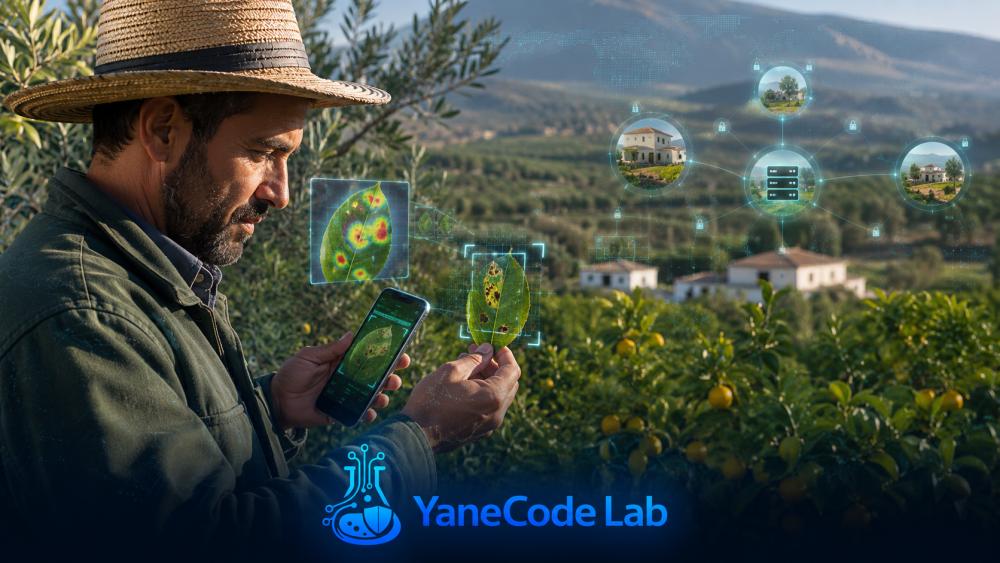
The project combines a lightweight backbone such as MobileViT or EfficientNet-Lite, knowledge distillation from a vision-language model, personalized federated aggregation with client-drift correction, domain-generalization techniques, and explainability through Grad-CAM or saliency maps validated with agronomy experts.
Expected Contribution
A rigorous evaluation of privacy, communication cost, and out-of-distribution robustness, together with a reproducible multi-region field-evaluation protocol for Mediterranean crops.
Expected Prototype
An offline-capable mobile application connected to a containerized federated aggregation server and a dashboard for monitoring training rounds and per-client metrics.
Datasets
PlantVillage and PlantDoc as pre-training datasets, complemented by an annotated field dataset collected from partner farms using geotagged smartphone images and phenological metadata.
Challenges
Rare-class imbalance, expert-annotation cost, client hardware heterogeneity, possible gradient leakage, and farmer acceptance of automated diagnostic recommendations.
Research Question
Innovation
Expected Deliverable
Technologies
Required Skills
- Deep Learning and Computer Vision (PyTorch)
- Federated Learning and Distributed Computing
- Embedded Model Optimization and Quantization
- Mobile or Embedded Development (Android, Raspberry Pi)
Datasets
- PlantVillage (Penn State / Hugging Face)
- PlantDoc (in-the-wild images)
- Field data collected from partner cooperatives