
Safe Reinforcement Learning for Deficit Irrigation Scheduling under Water Scarcity
Safe Reinforcement Learning for Deficit Irrigation Scheduling under Water Scarcity
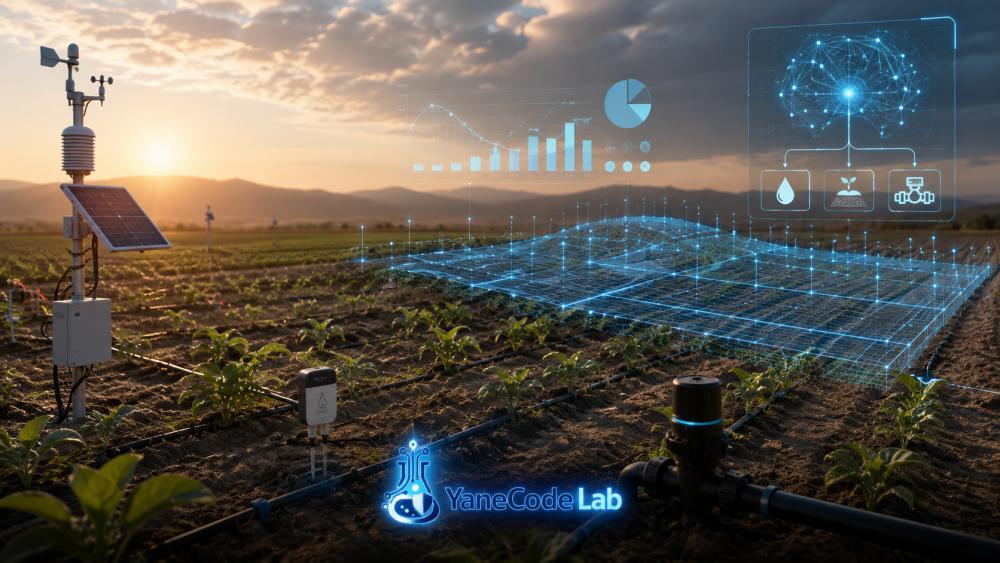
Description
Details
Context and Problem Statement
Water scarcity requires a transition toward controlled deficit irrigation, where moderate stress is strategically tolerated during less sensitive growth stages to maximize water productivity. Conventional rules often ignore weather uncertainty and real-time soil conditions, while unconstrained reinforcement learning is unsafe for real crops.
Research Question
How can hard agronomic and water-allocation constraints be guaranteed during both learning and deployment of an irrigation policy trained in simulation and transferred to the field?
Proposed Approach
The problem is formulated as a constrained Markov decision process using an AquaCrop or DSSAT digital twin coupled with probabilistic weather forecasts. Safe policy optimization, infeasible-action projection, domain randomization, and offline learning from irrigation history support simulation-to-field transfer.
Expected Contribution
A quantitative comparison among expert rules, model predictive control, and safe reinforcement learning in terms of yield, water productivity, and constraint violations.
Expected Prototype
An IoT-connected irrigation recommendation module reporting the proposed action, consumed water budget, and uncertainty on expected yield.
Datasets
ERA5, local weather stations, FAO AquaCrop parameters, and pilot-plot irrigation histories.
Challenges
Simulation-to-reality mismatch, soil-plant calibration, limited instrumented histories, and trade-offs between farm-level optimization and collective groundwater management.
Research Question
Innovation
Expected Deliverable
Technologies
Required Skills
- Reinforcement Learning and Optimization
- Agronomic and Hydrological Modeling
- Scientific Python Programming
- Embedded Systems and IoT Protocols
Datasets
- ERA5 (Copernicus Climate Data Store)
- AquaCrop crop parameters (FAO)
- Measurements from IoT stations on pilot plots