
Spatio-Temporal Graph Learning for Port Congestion and Container Dwell-Time Prediction
Spatio-Temporal Graph Learning for Port Congestion and Container Dwell-Time Prediction
Description
Details
Context and Problem Statement
Container dwell time results from interactions among berthing, crane availability, customs inspection, yard capacity, and truck-gate operations. Independent-stage models often miss propagation effects across the terminal.
Research Question
Does a spatio-temporal graph model that captures coupling among port resources significantly improve dwell-time prediction relative to independent models for each operational stage?
Proposed Approach
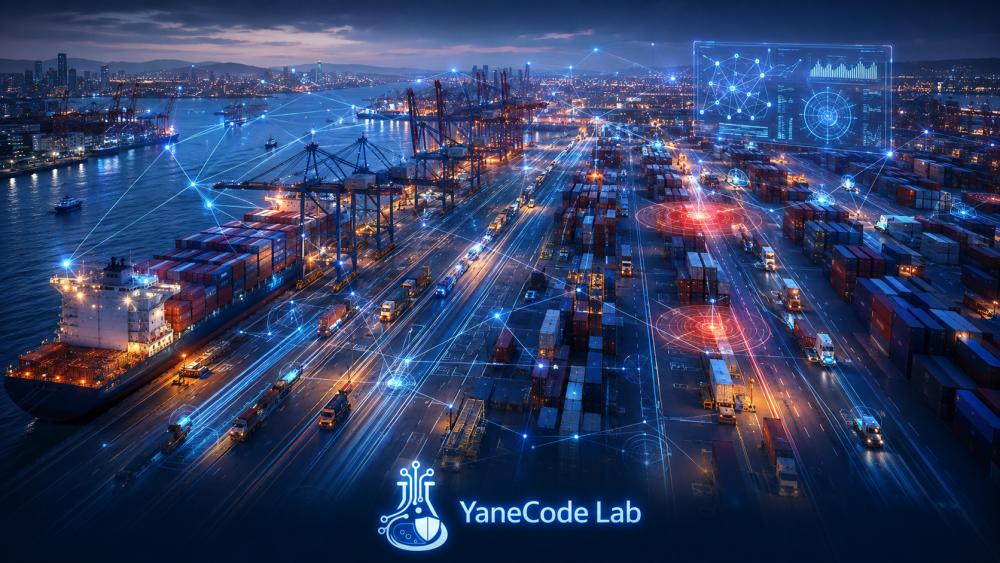
Represent the terminal as a heterogeneous graph of vessels, berths, yard zones, and truck gates. Train a spatio-temporal GNN with attention and evaluate it under rolling-horizon forecasting, complemented by counterfactual disruption analysis.
Expected Contribution
A quantitative assessment of the value of modeling operational coupling and a method for analyzing delay propagation.
Expected Prototype
A predictive dashboard showing expected dwell times, bottlenecks, and simulated disruption impacts.
Datasets
Public AIS maritime data, terminal operational data, weather series, and activity calendars.
Challenges
Commercially sensitive terminal data, rare high-impact events, organizational non-stationarity, and limits of observational causal inference.
Research Question
Innovation
Expected Deliverable
Technologies
Required Skills
- Graph Learning and Time-Series Modeling
- Port Operations Research
- Large-Scale Data Engineering
- Visualization and Decision Support
Datasets
- Public AIS maritime traffic data
- Operational data from a partner terminal
- Weather time series and activity calendars