
Time-Series Foundation Models for Few-Shot Probabilistic Forecasting at New Renewable Sites
Time-Series Foundation Models for Few-Shot Probabilistic Forecasting at New Renewable Sites
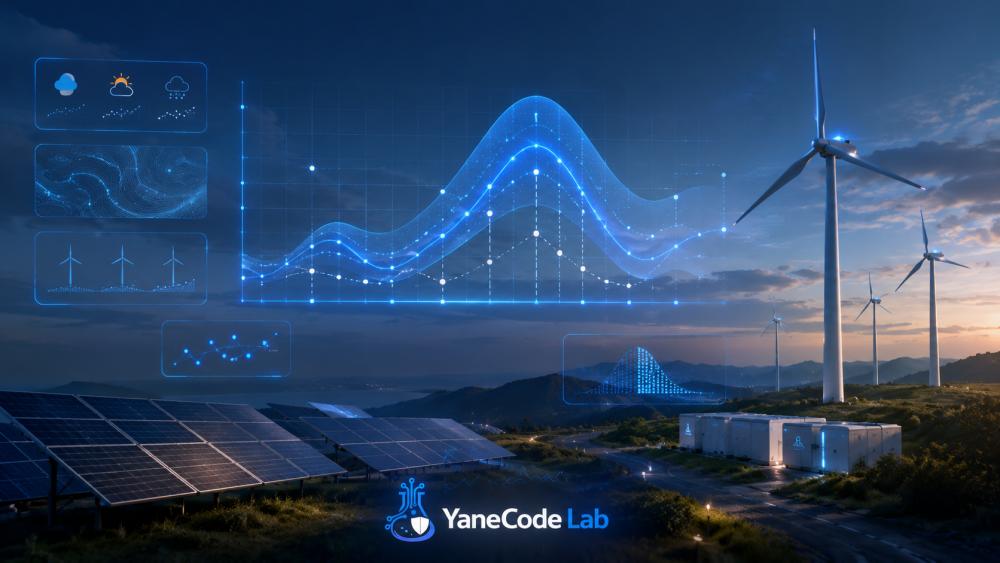
Description
Details
Context and Problem Statement
Wind and solar forecasting models often require years of site-specific history. Newly commissioned plants therefore have poor forecasts precisely when operational support is most needed.
Research Question
After how many weeks of site history does a calibrated time-series foundation model outperform local statistical models, and are its prediction intervals sufficiently calibrated for balancing decisions?
Proposed Approach
Compare time-series foundation models with statistical and locally trained deep baselines, add meteorological exogenous variables, apply conformal recalibration, and evaluate using CRPS and quantile coverage.
Expected Contribution
A characterization of the low-history regime in which foundation models provide genuine benefit and a practical recalibration methodology.
Expected Prototype
A day-ahead probabilistic forecasting service with continuous calibration monitoring and automatic model selection.
Datasets
ERA5, open wind and solar generation datasets, and partner production series.
Challenges
Possible pre-training contamination, inference cost, non-stationarity, outages, and lack of long reference histories for new sites.
Research Question
Innovation
Expected Deliverable
Technologies
Required Skills
- Time-Series Analysis and Statistical Forecasting
- Deep Learning and Pre-Trained Models
- Forecast Calibration Statistics
- Data Engineering
Datasets
- ERA5 (Copernicus Climate Data Store)
- Open wind and photovoltaic generation datasets
- Production series from a partner renewable-energy producer