
Uncertainty-Aware Edge AI for Chest Radiograph Screening in Primary Care Settings
Uncertainty-Aware Edge AI for Chest Radiograph Screening in Primary Care Settings
Description
Details
Context and Problem Statement
Chest-radiography AI can support regions with limited radiology capacity, but performance may degrade on older equipment, poor exposures, image artifacts, or population shifts. Silent degradation is clinically unsafe.
Research Question
Which out-of-distribution detection method can reliably identify images on which an embedded screening model should not make a prediction under strict computational constraints?
Proposed Approach
Train a compact model through knowledge distillation, add uncertainty mechanisms such as small ensembles, Monte-Carlo dropout, and energy scores, and evaluate under simulated acquisition and population shifts.
Expected Contribution
A rigorous comparison of OOD detection methods under edge constraints using safety-oriented metrics.
Expected Prototype
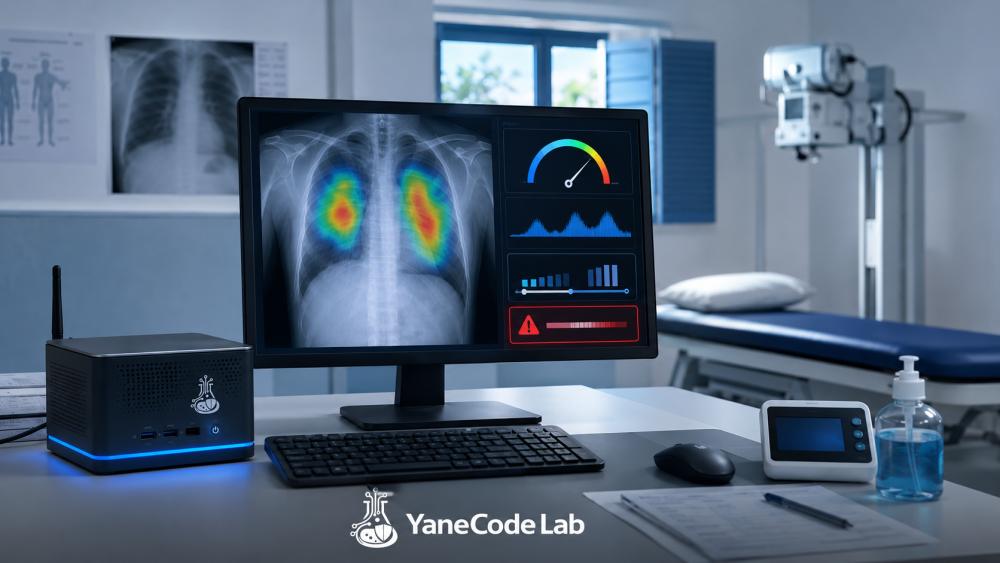
A low-cost offline pre-screening station that prioritizes cases and flags images requiring mandatory radiologist review.
Datasets
CheXpert, NIH ChestX-ray14, and a deliberately constructed OOD test set.
Challenges
Device shift, false negatives, lack of prospective validation, regulation, and preservation of clinician authority.
Research Question
Innovation
Expected Deliverable
Technologies
Required Skills
- Computer Vision and Medical Imaging
- Embedded Optimization and Deployment
- Uncertainty Quantification
- Medical-Device Regulation Fundamentals
Datasets
- CheXpert
- NIH ChestX-ray14
- Locally constructed out-of-distribution evaluation set